Wednesday, April 13, 2011

A statistical breakdown of the first round of the NHL playoffs

I have used the Glicko-2 rating system to rank each NHL team's regular season results and assign ratings. Each regulation and overtime win was counted as 1 point. A draw or shootout result was 1/2 point, and a loss was 0 points. These ratings are shown in Figure 1.


Figure 1. Glicko-2 ratings for NHL teams at the end of the 2010-2011 season. (Click for a bigger version.)


Because the rating system works best when games are played in groups of 10 to 20, the games were divided into five epochs of roughly equal size (~250 total games each). The first three were before the All-Star break; the last two were after. More recent games are given a higher weight in this rating system, reflecting changes over the course of the season. The mean rating is 1502. The median is 1514.

Very recent injuries/comebacks aren't accounted for. Nor is home ice advantage. Nor is the fact that regular season overtime is 4 on 4.

The error bars shown are a single rating-deviation (RD); 95% confidence is within 2 RD. Based on the results of the regular season, most teams are statistically indistinguishable. Only at the very bottom end is there a significant difference between teams.

Canucks fans: it could very likely have just been a long lucky streak. Deal with it. Despite the President's Trophy, there are other teams just as good. That's what you get when you play Colorado and Edmonton all year. Dallas fans: it's unfortunate your team was in such a tough division. Their rating was higher than several teams that made the playoffs. Probably in any other division, you'd have made it, too.

The volatilities of these ratings are shown in Figure 2.

Figure 2. Volatility of ratings given in Figure 1.

These volatilities are a somewhat abstract concept, but basically they measure how much a team's rating would change if it won or lost the next game. As a consequence, they're a measure of how "streaky" a team was during the season (sort of, with lots of glossing over). Look at the Devils. They were awful in the first half, then went on a huge run, and then faltered at the end. During this time, they lost to some very bad teams and beat some very good teams. This gives a high volatility. If you're into long-term gambling, and you're in it for the money, don't bet on volatile teams. If you're into long-term gambling for the excitement, bet on volatile teams. The mean and median of these is 0.06. (The specific numbers don't mean much... the relative numbers are more important.)

Now that we have a set of ratings, we can compare teams. Glicko ratings are based on the Elo system, so the standard Elo comparison was used. In a game between team A and team B, if the rating of A is RA it is expected that A will score EA points.
EA = QA/(QA + QB)

where
QA = 10RA/400.

A rating difference of 400 means that in a lot of head to head games, you will earn 10 times as many points as your opponent (where "points" are defined in the first paragraph, not the NHL standings). Equal ratings means you have equal chances of winning each game.

These odds are given in Figure 3 for each of the first round matchups.

Figure 3. Odds of winning a single game for each of the first round matchups. Percentages given are those of the home team (listed first on the x axis).


The chance of winning each series in k games is given in Figure 4.

Figure 4. Odds of winning the series in k games for each of the teams in the first round.


If a team has probability p of winning each game, then it has probability of winning the series in k games given by
p4 (1-p)k-4 C(k-1, 4-1),

where C(a,b) is read "a choose b."

Curiously, Pittsburgh is a home team underdog (though they just won game 1).

I've yet to work out the odds of each team making it to the finals. Stay tuned for a future post!

Tuesday, January 11, 2011

Medicine that doesn't work -- acupuncture and acupressure

Practice: Acupressure

In 15 words or less: Pressing on specific spots on the body stimulates healing.

Initial reaction: Seems pretty unlikely.

What it really is: In traditional Chinese medicine, they believed that the body was animated by a magical force (or energy?) called chi. There's something to do with yin and yang there, too, but it's all pretty self-contradictory. Anyway, the idea is that disease is caused by an unbalancing of yin and yang, possibly caused by an obstructed flow of chi. Manipulating certain points on the body redirects the flow of chi, curing ailments.

In acupuncture, you stick needles into the points to change the flow of chi.

In acupressure, you rub the points using one of about a dozen techniques. There are special wooden balls, or you can use your fingers, or your thumbs, or a martial artist with a 12th degree black belt can poke you and you'll die 3 days later from chi disruption.... (A similar thing led to a great storyline in Ranma 1/2, however, so I guess the practice isn't totally worthless.)

Occasionally, a small electrical current is applied to inserted needles. That does have a sort of plausible mechanism for doing things locally, but even then, it doesn't work as claimed by practioners.

Why they still say it works: No one can seem to give a good reason. It's a "prescientific" system, which I guess exempts it from having to actually work? The only even slightly possible reason I've ever heard is that it stimulates blood flow. But in that case, the specific points shouldn't matter, right? And going for a quick jog should, by that logic, cure even the most horrible diseases.

Why it doesn't work: There's no reason for it to work. You're not animated by magic. This might have been acceptable thinking 2000 years ago, but now? Get with the times.

Practitioners can't even agree on where the needles should go, or where they should rub. They don't agree for which conditions it might work. They don't agree on... well, on anything. That alone should indicate that it's a big sham.

A number of recent studies on a variety of conditions (arthritic pain, repetitive motion stream, for example) have showed that acupuncture with fake needles is no more effective than acupuncture with real needles.

The existence of chi points is resoundingly ruled out by other studies, which found that it doesn't work for back pain or nausea, either.

That's not to say there there is no effect. Of course there is the placebo effect... but fortunately, that works even if you tell the patient that you're using a placebo. There's no need to stick needles into people and risk infection, and there's definitely no need to pretend you know something about medicine when all you're doing is giving a glorified massage.

Resources: More information than you could ever want is at Skepdic.

Medicine that doesn't work -- homeopathy

Practice: Homeopathy

In 15 words or less: Like cures like; taking a very small amount of something bad cures related ills.

Initial reaction: Might work sometimes, similar to antivenins or vaccines.

What it really is: Say you have a headache, maybe caused by clogged sinuses. The homeopathic cure is to take something else that causes headaches--almost anything, no matter how unrelated--and dilute it in water by a factor of 1020 to 10200 (or sometimes more). The claim is that the more diluted the solution is, the more effective the cure will be.

Why they still say it works: Water has a "memory" of what chemicals it used to contain. Sometimes the word "quantum" is thrown around, too.

Why it doesn't work: This is going to be a long one.

Homeopathy started with a doctor in the days when they still used leeches to cure colds and were afraid of witchcraft. They used very dangerous medicines in those days, some of which had a reasonably high probability of killing patients. So this guy started diluting his medicines and noticed that more of his patients recovered. Hallelujah! He didn't compare the recovery rate of people taking homeopathic medicines to the rate of people who took no medicine at all (though he might have discovered the placebo effect if he had), and instead came up with the conclusion that "like cures like."

Sadly, water has no memory. Liquids are chaotic things, where the atoms are bouncing around like crazy. That's why they can flow. There is no internal structure that could possibly hold a memory of what was in there before.

And even if that was true, why should taking a poison that gives you a fever relieve a fever caused by a virus? It's like stepping lightly on an infected toe and hoping that that will stop it hurting. Obviously it's not going to work.

Then there are the dilutions. Some people arguing against homeopathy will say that not one molecule of the original "medicinal" ingredient is in the final solution. I disagree with this: there is almost always going to be some contamination from one dilution to the next, from not wiping the rim of the flask carefully or whatever. Anyway, say you use mercury as your ingredient. Do you think there's any chance that not a single atom of mercury ended up in that solution from some outside source? No. Even if you use distilled water, you're going to get a few atoms of whatever was originally in it. So the solutions aren't as diluted as they claim, and this contamination ruins any chance of a memory effect.

Say you did a dilution of 10100. You are claiming that for every atom in your original solution, you have effectively placed it in 10100 atoms of solution, and then taken a sample from that. How big is 10100? It is about 100,000,000,000,000,000,000 times as many atoms as there are in the Universe.

On the other hand, the amount of the medicinal ingredient actually present is incomprehensibly tiny. 18 grams of water has 60,000,000,000,000,000,000,000 atoms in it. If you're saying that there are only a few atoms in there, and that those are making a significant difference in the behaviour of that solution, then... well, if you had $60,000,000,000,000,000,000,000 in the bank, would saving a couple bucks on your new car be a priority for you? You could never even spend that much money, no matter how hard you tried. The antivenin/vaccine comparison is ridiculous.

So, the reasons it doesn't work are many. The medicinal ingredients don't have any reason to work. The dilution factor is too big for it to be plausible. There is more contamination than claimed.

And of course, it's easy to test. Down a bottle of homeopathic pills. It's been done many times, and no one has ever overdosed.

Reources:
There is a good article and many resources at QuackWatch. There is a line there which I find particularly amusing.
In 1994, the journal Pediatrics published an article claiming that homeopathic treatment had been demonstrated to be effective against mild cases of diarrhea among Nicaraguan children.... There was no public health significance because the only remedy needed for mild childhood diarrhea is adequate fluid intake to prevent or correct dehydration.
Dehydration is the one and only condition that homeopathy might have a chance of treating!

Friday, November 26, 2010

Quark-gluon plasma detected at the LHC!

I've been watching experiments running all month on the LHC web site, including those from ATLAS. You too can do so here. You can select what you want to see via the dropdown menu in the top left.

A paper showing the creation of a quark-gluon plasma at the LHC by the ATLAS experiment was accepted for publication today. A related experiment, CMS, is going to try to confirm this soon.

Quarks are the particles that make up protons, neutrons, and so forth. Gluons are the force particles that keep quarks stuck together. If you move two quarks apart, they create more gluons; unlike gravity and electromagnetism, which get weaker over long distances, the strong force (which is what we call the force that gluons carry) is stronger at longer distances. So you have to heat your quarks up a lot to get them to move apart significantly, and when you do, you get a lot of gluons being created. If you heat things up enough, the quarks from different nuclei will all mingle together in a sea of gluons, sort of like when you dissolve salt in water. This is called a plasma.

This event is important because it gives us details about the first few seconds of the Universe. These measurements might help explain why we have a lot of matter, but not much antimatter. New particles might be formed in the aftermath of such a plasma... perhaps dark matter particles, or the Higgs boson. We might even be able to discover new fundamental forces in such plasmas!

In related news, there is was a suggestion recently published that it might be possible to prove or disprove the hypothesis of supersymmetry very soon. Several groups of researchers have figured out what to look for, and it's within the capacity of the LHC to do it.

Exciting days ahead in the world of physics. You can get a schedule of the LHC's planned events online, if you're interested in the current state of affairs.

Thursday, November 25, 2010

Non-mathematical paradoxes

Someone wrote to me:


I always thought a paradox was two physicians.
But I'd like it explained why "we're damned if we do, and damned if we
don't."
I'd like a satisfactory explanation of "jumbo shrimp."
How about "Government Intelligence."
What about "lipstick?" It comes right off.


My responses:


Damned if we do, damned if we don't because I'm not a Christian.
Jumbo shrimp because the ones with floppy ears can't pronounce the letter D.
Government intelligence because intelligence implies penetrating thoughts, and
the government is always looking for ways to screw you.
Lipstick because it makes women look hotter, and therefore kisses last longer.


(Obviously not serious.)

Wednesday, November 24, 2010

Mathematical paradoxes -- The Two Envelopes Problem

The problem


Suppose you are given two envelopes with money in them. You are told that you may pick and keep only one of them. You are also told that one envelope contains twice as much money as the other, but not which envelope has more money. You choose one of the envelopes, and you find that it contains $10. Now, you are given the option of taking the other envelope instead. Is there any advantage to switching envelopes? How much money can you expect to gain/lose?


You might like to spend some time trying to figure it out. If I offered you the chance to buy the other envelope for $12, would you take it?


Math background


You need the ability to add and multiply. Dividing by 2 might help also. That's it! (It's great that some very complex problems don't need much knowledge of what most people think of as "math.")

The paradox


There are two common answers.

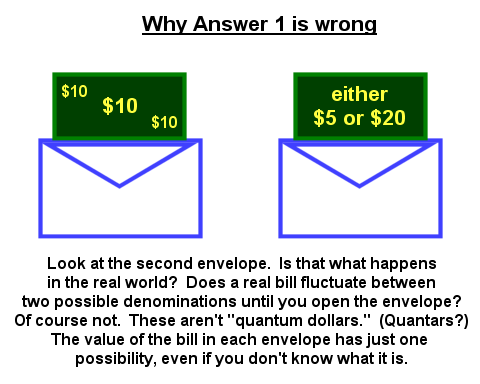
Answer 1: There are two options for what's in the other envelope. It either contains $5 or $20, with a 50% chance of each. On average, then, if you switch envelopes you will get ($5 + $20)/2 = $12.50. Keeping the $10 envelope only gets you $10. Therefore, you should switch, and you will get on average $12.50, for an average gain of $2.50.


Answer 2: Since you picked the first envelope randomly, it's impossible to gain by switching. You might have taken the higher number, and you might have taken the lower number. If you took the higher one, then you stand to lose the difference between the two envelopes. If you took the lower one, then you stand to gain that difference. Since there was a 50/50 chance of taking each, the differences balance out, and the average gain from switching envelopes is $0.


Which do you think is correct?


A more precise statement of the problem


  1. There are two envelopes with dollar amounts x and 2x. We'll say that envelope L has x and envelope H has 2x

  2. There is a probability of 50% of choosing each envelope.

  3. In one of the envelopes, the amount is $10.


The question: what is the average of the amount you would gain if you chose envelope L and the amount you would lose if you chose envelope H?


You might like to take a second to think about it again. Does that change your idea of what the answer is?


The solution


As for the Monty Hall problem, stating the problem more precisely makes it easier to figure out what the answer is. If you took envelope L, then you will gain x dollars if you switch. If you took envelope H, then you will gain x - 2x = -x dollars if you switch. (That is, you lose x dollars.) The average is (x + -x)/2 = 0.

But we can't accept this answer until we know why the other possible answer is wrong. After all, it's pretty intuitive. There is either double the amount in the other envelope, or there's half, and there is a 50% chance of each, right?

Well, no. To be precise (and you really have to be!), there is either a 100% chance of the other envelope having double the money as the one you chose, or there is a 100% chance of the other envelope having half. But that's not the same as saying there is a 50% chance of each. If you did an experiment where you had a constant number for the first envelope chosen (call it $10), and then either doubled it or halved it for the other envelope, then you would indeed benefit from switching envelopes. But that's not what is happening in the Two Envelopes Problem. That is a different problem entirely.


There's another way of looking at it. If you say,
  1. I have a chance of gaining $10, but I only have a chance of losing $5,

then you are assigning undue weight to the gains. It's more accurate to say
  1. If the other envelope has $5 in it, then I stand to lose $5 by switching. But if I'd chosen the other envelope first, I'd stand to gain $5.

  2. If the other envelope has $20 in it, then I stand to gain $10 by switching. But if I'd chosen the other envelope first, I'd stand to lose $10 by switching.

Do you see the difference? If you make the first statement, then you are assigning double the weight to the third statement compared to the second. You are saying something like "there is a 2/3 chance of statement 1 being correct, and a 1/3 chance of statement 2 being correct." (The 50% chance pertains only to whether or not you took H or L, so you can't even guess that statements 2 and 3 each have a 50% probability.) However, you simply don't know which of 2 and 3 is correct, so you can not assign odds to them. Because the first statement is assigning odds where it is impossible to do so, it isn't true.


Was your first idea right? Did you change your mind to the right answer after the problem was reworded?


Conclusion


In the Two Envelopes Problem, there is on average no gain to be had by switching envelopes. You will either gain x dollars or lose x dollars from the best-case scenario, and there's a 50% chance of each.

This is probably a great way to scam people. Put $10 and $20 in two envelopes, then let them look in one. Ask them to pay a bit under $12.50 if they chose the $10 envelope and want to switch, or a bit under $30 if they chose the $20 envelope. They'll think it's a great deal--on average, how can they lose?--but your gains from the people who choose the $20 envelope first will outweigh your losses from the people who chose the $10 envelope first. (Of course, you have to stipulate that they can't keep the first envelope they chose, or they're just going to take your money and run. Maybe. Some people don't like gambling.)

In practical terms, the amount of money you can offer is limited. If Alice offers two envelopes to Bob, and Bob opens an envelope to find $10 000, and he knows Alice's net worth is only $25 000, then he knows he must have opened the envelope with more money. For a similar reason, the amounts in both envelopes should be even numbers. I don't know if there's a way around this. Maybe selecting the amounts according so a distribution that puts emphasis on low values would work... but knowledge of the distribution might allow a savvy investor to beat the system. I think this is possibly a good research opportunity for someone (maybe me, after I'm done the current batch of papers I'm working on). The problem is because money isn't infinitely divisible. You can't offer someone 1/9 dollars. It's not obvious how finely divisible money has to be to make this scheme work.

Tuesday, November 23, 2010

Mathematical paradoxes -- The Monty Hall Problem

The problem


There was (and apparently still is! Wayne Brady runs it now!) a game show called Let's Make a Deal. It had a game in which the host--Monty Hall, after whom this problem is named--would show a contestant three doors. (I'm going to assume it's a female contestant here for the sake of clarity, to distinguish her from the distinguished Monty.) Behind one door was a car; behind each of the other two doors was a goat. The contestant would choose a door, and the host would open one of the other doors to reveal a goat. At this point, the contestant was given the choice to keep her original choice or to switch to the remaining unopened door. If the door she decided on in the end had the car behind it, the contestant won the car. (I don't know if they were allowed to keep the goat if they chose it. Probably they got to substitute another prize.) The question is: is there any advantage to switching doors?


What do you think? Would you switch doors, or would you keep the same one, or does it not matter?


Math background


All you really need to know is how to add and multiply. Easy enough, right? You could teach this to elementary school kids. (If anyone wants me to come to their classroom and teach it to their kids, I will do it!)

The paradox


There are three answers that people commonly come up with.

Answer 1: There can be no advantage. The door was originally chosen randomly, and the car is behind a random door. There are two doors after a goat is revealed, so the contestant has a 50% chance of having chosen the correct door.

Answer 2: Switching doors will give you a 2/3 chance of winning. There was a 1/3 chance of choosing the car in the first place, and then a goat was revealed, but that doesn't change the odds of finding the car behind the chosen door. If the contestant switches, there is a 2/3 chance of finding the car behind the other door.

Answer 3: Every door has something random behind it. No matter which door is choosen in the end, there is only a 1/3 chance of winning.


Which answer of these three do you think is best? Can you figure out why the others are wrong?


A more precise statement of the problem


  1. Two goats and a car are randomly placed behind 3 doors.

  2. The contestant picks any one door.

  3. If the contestant's door has the car behind it, the host picks either of the other doors. If the contestant's door has a goat behind it, the host picks the remaining door with a goat behind it.

  4. The contestant is given the option of keeping her door or switching her choice to the remaining unopened door.

  5. The contestant wins if her final choice of door has the car behind it.


What are the odds of winning if the contestant chooses to keep the same door? What if she switches?

The assumptions here are that all placements of the car are random, all episodes of the show are shown on TV (no bias in selection), and that the host always reveals a door with a goat behind it in step 3 (this is a bias, however). This is critical to the problem. If you assume that some episodes are never seen on TV, then you have an incomplete (and very possibly biased) view of the probabilities. In particular, if you exclude any scenario in which a car might be revealed, you get a different answer than if you don't.


Take a minute and think about it again. Do you agree with your earlier idea?


The solution


The more precise statement of the problem should clue you in to what's going on, especially step 3. If the host always had to choose to reveal one of the other doors at random, then each door would indeed be equally likely to have the car behind it. But that's not the case. However, just for the sake of comparison, let's look at each of the possibilities for this scenario. I've drawn these out in a tree form, because it's way easier to understand this way.

In the first column, I've shown the possibilities for which door the contestant first chooses. There is a 2/3 chance of choosing a goat, and 1/3 of choosing the car. In the second branch, I've shown the chances of the host picking either the car or a goat to reveal. Note that this doesn't happen in the game show; I'm just showing it for the purpose of comparison. In the final branch, I've shown what happens if the contestant switches doors or not. If the she wins the car, that's labelled win. If she gets a goat, it's lose.

For each winning possibility, I've multiplied all the probabilities from the left side of the tree to the win, and put that number at the end. For each loss, I put down 0 as the result. To get the total odds of winning by switching, add up each of the switch branches. To get the odds of winning by not switching, add up those branches.

In this case, there is a 1/3 chance of winning by switching, and a 1/3 chance of winning by not switching. There is also a 1/3 chance of the host opening the door with the car, and in that case you're not going to win no matter what you do. So there's no advantage to switching or not. Note that this diagram covers two of the commonly given answers above. If someone claims that there's a 50% chance of winning by switching, odds are she has calculated that the odds of winning and losing are the same and thinks that that means those odds are 50%. She has neglected the chance that it is impossible to win. If someone claims that the chance of winning by is 1/3 no matter what, then she has also chosen to use this diagram, and realizes that there's a chance of not winning.

However, I'd argue that that's not what the problem really is. On the TV show, the host always opened a door with a goat. It would make sense that if the contestant chose a goat in the first place, they always opened the other door with the goat. Otherwise, they'd have to throw out a third of their footage! (However, since we don't know for sure that this is the case, I won't argue too vigorously against it.) This distinction will become important when I discuss the Two Coins Paradox. In fact, it is a fundamental feature of experimental design: you have to know what your experiment is going to be before you do the experiment. In this case, the experiment might be a test to see if the "always switching" strategy works. To figure that out, you must know exactly how the test was done, and in particular, whether or not any possibilities are being discarded.

This diagram shows the correct solution. It is almost the same as the last diagram, except that the option of the host revealing the car is removed. You can see clearly that the odds of winning when you switch are 2/3, while the odds of winning if you don't switch are only 1/3. That is because no matter what your initial choice was, there is always a chance of winning. The bottom branch of the first diagram didn't have that choice.


Was your first idea right? Did you change your mind to the right answer after the problem was reworded?


Conclusion


Experimental design is important! You need to clearly define what you're trying to measure, or you can't do statistics on it!

If you clearly define the Monty Hall problem as "no matter what the contestant chooses, the host always picks a door with a goat," then the contestant doubles her chances of winning by switching doors. If you think, "the host opened a door at random, but they just didn't show the episodes where the host revealed the door with the car behind it," then there is no advantage to switching, and the contestant has a 1/3 chance of winning the car no matter what.

This is related to a statistical problem called Berkson's Paradox, and the "selection bias" that leads to the wrong answer is more formally called an ascertainment bias. The difference between this problem and Berkson's is that there is supposed to be an ascertainment bias here.


Sources:
1. Too much TV as a kid.
2. Image of Monty Hall from http://www.letsmakeadeal.com/images/mh-1975.jpg. I'm calling it fair use, for educational purposes.

Sunday, October 3, 2010

Blood colours

Just some fun facts that were sitting in a draft article that I will never finish. It's been a year since I last posted on this blog, mostly because I was busy finishing my master's thesis, and partly because I was getting bored with the whole "reporting news" thing. So I'm going to change things up a bit, I think. I'll start posting single interesting articles as I come across them, rather than a weekly digest (which was something of a chore), and I also want to do some fun math/science things.

Most mammals have the familiar red blood that we all know and love. The colour is mostly due to the presence of the iron-based molecule hemoglobin. Spiders have copper-based blood (same as crabs, hemocyanin) which is blue or green or sometimes yellowy. Some worms (Polychaeta) have blood which is green/bright red (chlorocruorin, iron-based), depending on conditions. Some other worms (mostly deep sea worms) have a different colour of red (hemerythrin, iron). Sea squirts and tunicates have a pale green blood pigment (vanadium chromagen, clearly vanadium-based, but with the vanadium possibly in several different oxidation states) which can, depending on other chemicals present be blue, orange, yellow or pink (or basically anything). Some molluscs have brown blood (pinnaglobin, manganese).

There are many others, some of which are mentioned in a neat little book about extraterrestrials. Xenology: An Introduction to the Scientific Study of Extraterrestrial Life, Intelligence, and Civilization.

Sunday, November 15, 2009

E.S.S.D. -- Two card monte

E.S.S.D. -- Experiments someone (else) should do


This is the first in my list of experiments I think someone should do. The idea is that one of my unemployed friends might see this, think "hey, that'd be a neat project," and then do it, simultaneously satisfying my curiosity and turning that person into a slightly useful member of society. Either that, or somebody looking for a neat science fair project might be looking for something original. As far as I know, the answers to the E.S.S.D. questions will be unknown, or I won't be sure if the method will work.

Title: Two card monte
Field: psychology
Difficulty: as hard as you want
Importance to science: probably none

Introduction: Here's one of my favourite magic tricks. I have two cards.


One is the 3 of spades.

The other is the queen of hearts.

Now, I show you these cards a couple of times, then slowly take the 3 and put it behind my back. I ask you what card went behind my back. You, of course, say the 3, but when I take it out, it's the queen. And I show you again that I have only two cards.

If you look closely at those pictures, you'll probably figure out what I'm doing. But here's the thing. To some people, I can do this trick 40 times, and they won't get it. They just get increasingly baffled and amazed. Other people, maybe 1 in 50, pick up the trick right away.

So what causes some people to figure it out immediately, while others never do? I have done this trick for hundreds of people. Maybe a thousand, or two thousand. And my observation is that the people who figure it out are most often "grabby" people. Small children, mostly, but also adults who have an impulse to reach out and grab the cards as soon as I pull them out. Most people aren't rude enough to actually grab the cards, but I can tell immediately by the twitch of a hand that this trick will probably not work on that person.

So if you haven't figured it out yet, look at the first picture again, and imagine yourself touching the 3. Then look at the second picture.

So that's the experiment. Does actually touching the object change how the viewer perceives it? Does just the thought of touching it change it? You could show this trick to three samples of people who have never seen it. One group is instructed to touch the card before they are turned over. One is instructed to think about touching it. One, the control group, gets no instructions. (Maybe a post-trick questionnaire could separate those in the control group who thought about touching it from those who didn't.) You'd need a consistent way of presenting the trick... a robot or a video. Maybe do it five times, and see if it takes certain groups longer to figure it out. Control for age, sex, et cetera.

There could be some genuine psychological principles in this. But at the very least, it'd make for a difficult experimental design that would be fun to do. There are all sorts of possibilities for playing with statistics. And you'd get to trick a lot of people, all in the name of science.

**************************************************

Leonid meteor shower!

The Leonid meteor shower is on now! Sadly, it is overcast and snowing here, but maybe if you live somewhere good, you can see it? I believe the peak is somewhere around tomorrow night, but obviously it should be good for a few days.

They are expecting near the peak something like a dozen per hour (sadly, not the five hundred per hour that the Facebook event reports). The excellently-named Fluxtimator can give you details.

**************************************************

AWoS vol. 1, no. 4 -- Sex, more from LCROSS, a speech gene, curing people with HIV

Rabbits get functional artificial penises


I don't know how much I want to write about this one. Let's just say that with a lack of permanent consequences, John Bobbit-like incidents could end up being more common. An argument against advancing science if I've ever heard one.

Okay, so the implications are important. We're now able to go into a lab, grow tissue that otherwise wouldn't regrow, and implant it into you. They did it with bladders. They've figured out how to do with with hearts (using a neat cartilage shell). Pretty soon, any organ you need with be grown for you. Organ donors won't be a thing of the past, exactly, but they'll only be necessary for emergency purposes. Even then, I can envision hospitals keeping a few samples of each organ in the incubator at all times, just in case.

So yes, not only is there a decent chance that you're not going to die, ever--except perhaps through some horrible meeting with the front end of a moving truck--but if you survive that accident and your penis gets damaged, they can fix it too.


More from LCROSS


There is water on the Moon.

Not very much water, mind, but it's enough to get people excited. There are implications for one day putting a colony/research station up there: if there is water, then we don't have to drag our own up there.

Even more interesting, I think, is the detection of hydrocarbons. They ought to be common in space, forming on the surfaces of the dust grains that get blown out by exploding stars. A few chemical signatures of organic molecules have been detected out in space, but it's hard to say just how much is out there. The dark craters of the Moon, however, act as a sort of trap for all the crud that floats through our solar system, and the detection of hydrocarbons in there means that there must be more floating all around us in space.

It will be interesting to see if the experts can draw any conclusions about hydrocarbons in space from this data. After all, if organic molecules are abundant in space (and it appears that they are), then maybe that will mean life is commonplace throughout the Universe.

Hey, the Moon has oil on it! No wonder the USA bombed it! This particular mission only cost half a billion, though... a far better investment than other, similar endeavours.


A speech gene


Well, sort of. There have been reports in the newspapers about the discovery of a language gene in humans. The truth about FOXP2 is way more interesting. A single change in a single nucleotide... well, read for yourself.

This could be corrected, perhaps, through gene therapy. If only there were a way to insert the proper genes....


Curing people with HIV


No, not curing people who have HIV, but using HIV to cure people (with other diseases).

The reason diseases like HIV and hepatitis B are so bad is that they are caused by a type of virus called a retrovirus. What this means is that the virus actually inserts its own genetic code into the genes of the organism it is infecting. With influenza, for instance, your body eventually kills the invading viruses, and then it is gone. But with retroviruses, even after your immune system has killed the viruses, the code for making more stays inside your cells, meaning that you will infect yourself over and over again.

However, medical science can take advantage of this! Researchers are now using a part of the HIV virus (the insert-into-genes part) to insert genes for making an enzyme called ALD to break down certain fatty acids into patients with a disease also called ALD (which is, of course, caused by an inability to break down fatty acids). This isn't a completely new idea, but it's one of the first major successes I've read about.

The usual method for curing this is bone marrow transplants. Unfortunately, marrow is hard to come by, and because it's intimately involved in the immune system, the body tends to reject it. Inserting new genes gets around these problems.

This bodes well for the future! One can imagine that maybe diabetes will be cured in a similar way, or anemia, or pretty much any other chronic disease. Remember how a few weeks ago they were curing Parkinson's with gene therapy? Remember how five paragraphs ago they discovered what was causing speech problems in certain people?

(Also, maybe we'll one day be able to change our eye colour on the fly, by inserting the right genes in there. Awesome.)

For more on this specific study, read the article linked from this section's title. It's very well written, far better than I can do. But as you read it, think of how far the implications reach....


That's all I have for this week. In the coming days, expect descriptions of a couple of experiments that someone should do, and maybe a little writeup on a chemist who is unknown today, but was one of the greatest in his time. Also, I might translate this into regular English for you, because it's actually pretty neat. (That issue of JPC A has no fewer than ten articles I really want to read, so I might get too distracted....)
**************************************************

Back after three weeks!

After a longish absence, AWoS is back. If you are interested in excuses and/or mysterious explosions, read on.

Basically, three weeks ago I dropped my laptop, upon which was all my work, research, and so forth. I picked it up, stood, and for whatever reason opened my hands. The hard drive is mostly functional, but it seems that there is an enormous section of the disk that can no longer be read or written. That enormous section included the boot sector and most of Windows.

In this way, that computer can not be started until I can afford a new hard drive.

But I have a desktop machine. The trouble is that it didn't work for several months until earlier this week. (I hadn't had time to diagnose it.) Over the past few years, I have occasionally heard an enormous popping sound/small explosion right next to me as I worked. At first I thought it was a faulty outlet, but that turned out not to be. Then I thought that my shelves might be collapsing. Nope.

When I finally went to fix my desktop machine, I discovered why.


Capacitor plague! There are eight--count 'em, eight--faulty capacitors on my video card. This is probably not good. (On the other hand, I'm impressed that it still ran with seven of them gone.)

Anyway, I am currently running with an old (ca. 2000) video card that is good enough, and will be posting regularly again! I have a bunch of special features planned, so get ready!
**************************************************

Friday, October 23, 2009

Happy Mole Day!

Today is a day for celebrating one of the most beloved of physical quantities, the mole. Calloo, callay!

(I note that the Mole Day web site, linked in the title of this article, has crashed, most likely due to traffic from mole enthusiasts around the world.)

**************************************************

Wednesday, October 21, 2009

The worst (fictional) science experiment ever

Earlier, I talked about how silly the science in Dan Brown's The Lost Symbol is. Well, I'd like to talk about one of the experiments in there that, if done in real life, would qualify for an Ig Nobel prize.

This is from page 392 in my copy:

The machine did look a bit like the transparent incubators for premature babies one saw in hospitals. This machine, however, was adult size--a long, airtight, clear plastic capsule, like some kind of futuristic sleeping pod. It sat atop a large piece of electronic gear.

"See if this helps you guess," Katherine said, plugging the contraption into a power source. A digital display lit up on the machine, its numbers jumping around as she carefully calibrated some dials.

When she was done, the display read:
0.0000000000 kg


I counted. That's ten zeroes after the decimal. (Calibrating dials looks scientific!) It goes on...

Katherine took a tiny scrap of paper off a nearby counter and laid it gently on top of the capsule. The numbers on the display jumped around again and then settle on a new reading. .0008194325 kg


We'll assume that the lack of a leading zero in the second case is just a typo, and not the instrument going crazy. Or can we assume that?

Let's think about this for a second. The machine is settling--settling-- on a reading between 0.00000000045 kg and 0.00000000055 kg. Those are staggeringly small numbers. What does your breath weigh? What about air currents in the room? She just moved her hand near the scale: that's going to set off all kinds of air currents! And they're breathing. And there is still air circulating from when they opened the door to enter the room. And so on.

It is my experience with balances (and I have used many), that measuring anything under about a milligram (0.000001 kg) is not possible unless you seal the thing off in an airtight compartment and let it sit untouched for a long time. Things at a tenth of a milligram almost never stabilize in most labs. But we're supposed to believe that this scale is stable enough in an open room to measure something 10000 times lighter, in real time!

Later on, it is revealed that the scientist in the book put a guy into this capsule. The reading was stable at 51.4534644 kg. Not sure where the extra decimal places went. Anyway, the guy was dying, but still alive. And the scale stabilized at a tenth of a milligram! Nuh-uh, no way, no how. There were even people in the room with the scale. The guy's wife had just closed the lid. The motions of the man in the capsule alone would overwhelm any readings you might get, causing fluctuations in the scale even at the gram level (0.001 kg).

Then the guy died, and shortly after the number on the scale dropped a tiny bit. This was supposed to be conclusive, irrefutable evidence that the human soul had mass. Ugh.

"But Glen," you say, "surely this kind of thing does not happen in real life?" Sadly, it does. There was a researcher and 2-time Ig Nobel winner named Jacques Benveniste who specialized in this stuff. He invented a device for measuring electromagnetic emissions, like radio waves or light. (Benveniste used his device to transmit medicine over the Internet. Like, you'd hold up your modem to a vial of water, and it would turn into Viagra or something. He claimed success. Most of the rest of the world mocked him.)

The device is a glorified microphone, really, hooked up to a powerful amplifier. Now, what happens when you hook up a mic (or a record player) to an amp? You get a hiss, of course. It may be a big hiss, or it may be small, depending upon your equipment, but there is always some noise.

Occasionally there are loud blips. A bit of dust falls on the mic. You shift the cord. The power supply into your house fluctuates a tiny bit as your neighbour turns on the vacuum cleaner. Noise is a part of life, and a part of any scientific data collection.

Trouble arises when you try to interpret that noise. One of last year's Nobel Prize winners, Luc Montagnier, appears to have fallen victim to this. Read that article. It's good.

From a scientifically-minded reader's perspective, that's what happened to the scientist in The Lost Symbol. She used a similar device for measurement, with all the same problems, and she wanted to believe, so she (subconsciously) rigged her experiment, cherry-picking the data she wanted to see. And everyone else believed it, too. Maybe that's partly why I didn't like the book. I don't mind rooting for characters who aren't perfect, but when every single one is that gullible.... In a story where critical thinking is supposed to save the day, things like make the protagonists' succes completely unbelievable.

**************************************************

Orionid meteor shower!

I completely forgot to mention this, but the Orionid meteor shower is peaking right now. Sadly, it is too cloudy where I am, but if you're awake, go outside and look around. If you missed the peak tonight, do not fret: there have been many meteors all week, and there will probably continue to be many for a few more days.

NASA has some details.

**************************************************

Sunday, October 18, 2009

AWoS vol. 1, no. 3 -- Space strikes back!, flies, nearly curing Parkinson's, NEPTUNE, bending light, ptransitional pterodactyl, IBEX results

Hi everyone, and welcome to AWoS. There was a swack of good science reported this week, so much that I can't write it all up here. For those reading on the blog page, you may notice a set of links on the right hand side. Those are the main science-related things I read every week. (Well, in addition to some more technical journals.) But if it's mid-week and you're looking for something interesting, they are good places to look! Plus, ScienceNOW, the news arm of Science, has a Facebook group that will send you interesting stuff all week.

Anyway, let's get to the week's happenings!

Space strikes back! (Pre-emptively!)


Last week, I wrote about how we bombed the Moon. It is now being reported that on September 25, space attacked us!

A family in Ontario woke up to find that their car had been vandalized. The hood was smashed in, and there were rock fragments all around. They filed a police report and left it at that. But later, they heard about an exceptionally bright meteor that had been spotted over Ontario and put the facts together.

Unfortunately, they didn't get much rock out of it. A larger chunk could have paid for the repairs.


Fruit flies are the best


Two stories involving Drosophila this week.

The first is that mind control took one step closer to reality. Researchers took some fruit flies and labelled their brain cells so that they could read which ones were responsible for associating a particular smell with an electric shock. This is a pretty good feat in itself: they managed to find that only 12 neurons were responsible for this.

Then they gave different flies some chemicals that would activate brain cells. A tricky bit was in releasing those chemicals. You don't want them just floating everywhere, or else every neuron gets activated, so they made them light-sensitive. Now, instead of shocking the fly when the smell was present, they shone light on the proper cells. Amazingly, the chemical/light-treated flies learned to be scared of the smell in the same way that the shocked flies did.

I'm not sure how I feel about this. On the one hand, science fiction teaches us that mind control is bad. On the other hand, if I could learn all there is to know about physics just by injecting chemicals into my brain and shining some light inside my head, that would save me a lot of school work.

The second story is responsible for the funniest picture ever published in an esteemed science journal. I present it here for your amusement.

It was discovered that male fruit flies will mate with anything that is fly-shaped, regardless of species or gender, if the proper chemical cues identifying those characteristics are not there. Females, on the other hand, have no interest in males without the proper chemicals. (A cynic might apply this to human behaviour by replacing "the proper chemicals" with "wads of cash.")

(If you follow the link above, you will see a picture in which they use green fluorescent protein, the creation of which won the Nobel Prize last year.)


Progress in treating Parkinson's


For all the talk about animal discoveries, it's sometimes easy to forget how much these studies affect people.

Parkinson's disease is caused when the brain cells responsible for producing dopamine don't function properly. Dopamine is a neurotransmitter, meaning that it helps to send signals between nerve cells (and brain cells). When the body lacks enough dopamine, signals either can't go through or don't go through properly. This leads to muscle tremors, difficulty in moving, and eventually paralysis. There are all sorts of nasty side effects: if you don't blink enough, then your eyes get sores, for instance.

The standard treatment is to give doses of L-DOPA, which the brain converts into dopamine. The problem is that it gets converted everywhere in the body, leading to dopamine excesses, which in turn cause a loss of fine motor control, and eventually cause liver failure (among other problems). Other experimental treatments are more radical, including wire implants in the brain to stimulate the appropriate brain cells.

Parkinson's is a difficult thing to diagnose, in part because there may be many different ways it can occur. Several different mechanisms have been proposed, and from the evidence, it looks like different people may get the disease for different reasons. That makes finding a cure a difficult prospect.

But there is hope. Stéphane Palfi and co-workers gave some monkeys the equivalent of advanced Parkinson's by injecting them with poisons that disabled their dopamine-producing brain cells. Then, they injected three genes responsible for producing dopamine into the monkeys' brains. The monkeys recovered, and don't appear to show any side-effects.

This is not a cure, exactly. Whatever is affecting the original cells is still there. But by having a different path to produce dopamine, the problems associated with the disease disappear. The down side is that you can't control just how much dopamine is being produced in this way, but it looks like the genes given to the monkeys are regulating themselves.

They're currently starting human trials on this. I don't know if the gene therapy needs to be repeated over time, or if it's a one time thing, but this is good news for a lot of people.


Ocean observations


A few years ago, I went to a high performance computing conference at which the guest speaker spoke about a project called NEPTUNE. He'd just come back from a trip to place sensors all over the ocean floor near Vancouver Island, and had interesting things to say. Their technical stuff was amazing: a big power line into which new sensors could be plugged as they were developed, live data acquisition, and a variety of instruments that would give unprecedented measurements of the ocean floor, both in terms of geology and biology. Check out some of the images.

I was reminded this week of NEPTUNE by news that the USA's stimulus package included $100 million for the Ocean Observatories Initiative. Good stuff! They're planning on doing around the world what NEPTUNE is doing off Vancouver Island.


Bending light


We've all heard about the technology to make invisibility a reality, right? You may recall breathless news reports from last year which invoked the name of Harry Potter and an invisibility cloak. Of course, those were massively overblown--the materials used were only created on a small scale. But it is still interesting.

There's a nice little writeup on metamaterials here, if you missed the hype at the time, and a less accurate but easier to read one here. The exciting part, for physics people, is the phrase " in 2000... a metamaterial was demonstrated to have a permittivity and permeability both less than zero." For non-physicists, that means you can do things with light that don't normally happen, like bend it around objects in weird ways, or make magnetic and electric fields go backwards to what you'd normally expect.

The same technology has been used to capture microwave light and focus it on a point to create heat. Big deal, you say, I used to do that with ants and a magnifying glass all the time. True enough, but what's special here is that essentially all the sunlight being captured is turned to heat: with your magnifying glass, you were getting at best 30%. This has big implications for some types of solar energy.

The authors of the article call their discovery a "black hole." Obviously, this isn't a real black hole. What they mean is that they've developed a device from which light at certain frequencies can't escape because of the electromagnetic properties of the material used. For a real black hole, no light can escape because of gravity. Completely different, and just titled like that to catch attention.


Ptransitional pterodactyl


More dinosaur news from China: the discovery of Darwinopterus modular. This is a pterosaur from the Middle Jurassic (call it 165 million years ago) which seems to bridge the gap between primitive pterosaurs and the later pterodactyloids in an interesting way.

The article itself has a pretty chart showing the relationships between the various pterosaurs, and if you love these things as much as I do, you will want to browse The Pterosaur Database. Open the pretty chart, if you will. I'm going to refer to it soon.

Darwinopterus is interesting to evolutionary biologists because its existence supports an idea called modular evolution. We all know how evolution works: creatures more adapted to their environment are more likely to reproduce, so the genes that make them more adapted get passed on. The questions that biologists ask relate to how fast evolution occurs. In particular, is it constant through time, with large external pressures and extinction events only contributing by wiping out the weak, or does evolution happen mostly during these events, and very little during stable periods? (Darwin, after whom this dinosaur is named, favoured the idea that most evolution happened quickly, but also knew that it could occur slowly and steadily as well. This is because he was a very great man who made careful observations and thought hard.)

Modular evolution proposes that creatures evolve in modules. One piece gets adapted. Then another. Then another. I don't know what the name for the other kind is, where everything develops simultaneously.

Darwinopterus has the skull (and some other features) of a late pterodactyloid, but the tail of an early pterosaur. If you leave out the skull, then it looks exactly like a reptile in the red group in that pretty chart. If you leave out the tail, it looks exactly like it should be in the blue group. (These are marked by D1 and D2 on the left side of the diagram. The creature itself fits into the purple bracket, number 7).

So it looks like the modular evolution theory holds in this case. The transition from early flying reptiles to late flying reptiles happened one characteristic at a time, probably brought about by abrupt changes in prey or climate. (When I say "abrupt," I mean "over only a couple million years.") It's probably not good to conclude that all evolution occurs this way, though, which is what some of the newspaper articles are implying.

Pterosaurs: they're like Tyrannosaurs in F-14s.


High pressure region in the heliopause, and first direct detection of H and O in the ISM


Titles like that are awesome. They sound sciency.

At the edge of our solar system, well beyond Pluto, there is a divider. At this divider, the particles spit off by the Sun (called the solar wind) hit the cold bubble of interstellar space. Our solar system is in a bubble, of sorts. Space is full of gas (the interstellar medium, or ISM), and the solar wind is pushing this gas away. But it can only push so far, and the region where particles from the Sun are stopped is called the heliopause. It's not spherical, but no one's really sure why. In fact, no one's sure about much with regards to this region.

The Interstellar Boundary Explorer (IBEX) was built to study the edges of our solar system. It just returned its first results, and they are strange indeed. It has found a ribbon of dense material in the heliopause. They're attributing this to magnetic fields in the interstellar medium, which means all sorts of exciting new science is there to be done. We know almost nothing about how the ISM works, and this is a great start. (Did you know we don't even know if our galaxy has two or four arms? Weird, huh? We know tons of stuff about distant galaxies, but don't even know what our own looks like.)

IBEX is neat because it uses a special method of observation. Normal telescopes pick up light of various frequencies. However, the ISM consists mostly of neutral atoms, which don't emit light, at least not light that we can see. So IBEX was built to capture energetic neutral atoms, or ENAs. When our solar wind comes into contact with the ISM, some of the slow ISM atoms get accelerated, and some of these get shot toward the centre of the Solar System, where we are.

I'm curious, now. Voyager I is out in this ribbon. Where did the Pioneer craft go? Could something like this, an unexpectedly large number of incoming energetic neutral particles, be the cause of the Pioneer anomaly? They meet the criteria: they would slow a spacecraft's acceleration outwards and are otherwise invisible. It would be interesting to compare IBEX's sky map with the trajectories of the spacecraft affected to see if there is a link (of course, taking into account the effect of the Sun's shielding).


Fractional Hall Effect in graphene


I'm just going to link to this and let you read it. Fractional electron charges? The world gets ever weirder.


That's all for this week! I'm going to make myself an origami pterosaur! Coming during the week: another complaint about Dan Brown's latest book (hint--don't read it if you value your sanity), and a few simple science projects that someone should do.


**************************************************

Wednesday, October 14, 2009

Science in popular fiction - The Lost Symbol

Recently, I have been reading The Lost Symbol, the latest book by Dan Brown. You have likely heard of this book; it sold about a zillion copies in its first few days. It is the sequel to The Da Vinci Code, which sold many zillions. (The movie version of the latter introduced the supremely talented and elegant Audrey Tautou to North America, which promptly overlooked her for the latest American Idol floozy. So she decided to only do movies in France, which is probably for the best, really.)

As you can possibly tell, I am in a bad mood. I have wasted nearly an hour of my life reading this book already, and with 400 pages to go, I will have to spend another 4 hours just to say I finished the book.

Okay, so maybe it will turn out okay. I thought The Da Vinci Code was great, probably helped a lot by the fact that I had the version with colour pictures of all the landmarks. Angels & Demons, the first book in the series, was reasonably fun, but the science bits were terrible. Really terrible. 2000s Michael Crichton-terrible. But at least they didn't play into the story too much. They just established that maybe it was okay for a particle physicist to be religious. Fine. Oh, and the female lead had completely overthrown the established laws of physics, but that was mentioned in passing just to make her look cool. I get it. She's hot, and smart, which is also hot. Angels & Demons moved on to the story of blowing people up.

The Lost Symbol takes things a step further, though. Instead of just making up some fake science for us to choke down, Dan Brown does something awful. He takes a branch of ridiculous pseudoscience and not only legitimizes it, but makes it an integral part of the story. (So far as I can tell. Maybe he'll abandon it soon and get back to telling me about how some arch or another actually represents some part of the female anatomy.)

The "science" in question is called noetic science. Some people (weasel words, I know, but I'm too lazy to tell you just who) like to capitalize it: Noetic Science. The Institute of Noetic Sciences "conducts and sponsors leading-edge research into the potentials and powers of consciousness." They define noetic science as
Noetic sciences are explorations into the nature and potentials of consciousness using multiple ways of knowing—including intuition, feeling, reason, and the senses. Noetic sciences explore the "inner cosmos" of the mind (consciousness, soul, spirit) and how it relates to the "outer cosmos" of the physical world.


You should be rolling your eyes, sighing heavily, and if religious, saying, "Good Lord."

The reason this irks me is that when people learn what I study, I commonly get asked questions regarding the connection between quantum physics and philosophy. Now, I'm not a quantum physicist, but I've read hundreds of papers, worked through graduate level texts, and even experimented with efficient ways of performing the calculations. So I think I have a reasonably good idea about how this stuff works. But when I explain to people that no, Zen Buddhism did not predict quantum phenomena, and no, homeopathy can not possibly work because quantum theory does not work that way, and yes, the Universe exists independently of whether or not you look at it... well, they get upset.

In his book, Dan Brown write a near carbon copy of a conversation I have had. And in the book, the scientist gives in to the woo-woo supporter and goes on to turn his ideas into world-changing research. Now, to my mind, this is a clear case of the scientist going crazy and building herself a fantasy world in which she is important, and if she were the main character, I would be happy to interpret the book this way. However, because she is not the main character, the things described for her are objective... meaning the author is taking the premise that this is possible.

I'd rather read about super-intelligent slugs, because they are more believable.

Here's one offending passage (with some comments interlaced):

Her brother ran a finger down the long shelf of cracked leather bindings and old dusty tomes. "The scientific wisdom of the ancients was staggering... modern physics is only now beginning to comprehend it all.""

"Peter," she said, "you already told me that the Egyptians understood levers and pulleys long before Newton, and that the early alchemistsdid work on a par with modern chemistry,

Stop right there! No, no, no. Just no.

but so what? Today's physics deals with concepts that would have been unimaginable to the ancients.

Tell it like it is, sister.

"Like what?"

"Well...like entanglement theory, for one!" Subatomic research had now proven categorically that all matter was interconnected... entangled in a single unified mesh... a kind of universal oneness. "You're telling me the ancients sat around discussing entanglement theory?"

"Absolutely!" Peter said, pushing his long, dark bangs out of his eyes. "Entanglement was at the core of primeval beliefs. Its names are as old as history itself... Dharmakaya, Tao, Brahman. In fact, man's oldest spiritual quest was to perceive his own entanglement, to sense his own interconnection with all things. He has always wanted to become 'one' with the universe... to achieve the state of 'at-one-ment.'"


See what I'm saying? He's actually supporting this crap.

Here's the difference between ancient philosophy and modern science. Some ancient philosopher or another said everything. They took all the possible ideas, loaded them into a shotgun, and spun in circles, firing blindly. Take a concept vague enough, and it's bound to coincide in some way with a fact. But a scientist looks at the facts first, then makes testable predictions. Quantified... you know, with numbers and math and stuff. And then we test it, and see if it's true, and modify it as need be.

In particular, science talks about very specific things. We can say, "if I take measurements near this atom, here's how likely I am to spot an electron within a certain distance of the nucleus." And that's all that quantum theory applies to. It doesn't mean that waving a crystal over your orange juice will help you cure your cold. That's witchcraft.

In this particular example, quantum entanglement is the idea that you can figure out some information abut one particle by measuring a specially prepared related particle. You measure one, and instantly know something about the other. But that's all it is. It's got nothing to do with how much you love your pet rock. Tao did not predict this. He didn't know what an electron was. The concept is highly insulting to real scientists.

I could spend days tearing apart the bad science in The Lost Symbol, but I won't. I'll just mention the two that follow this passage. Peter says that polarity (what he describes as "positive and negative charges of the subatomic realm," though there are other meanings within physics) was "the 'dual world' described by Krishna." Garbage: if Krishna had said, "there are two things and they attract each other and that attraction obeys an inverse square law," then I'd listen. But just saying, "there are two sides to the world" doesn't mean squat.

Then he goes on to say that Heisenberg and Schrödinger said that they got the basics of quantum theory from Hindu mystic writings. Absolutely ridiculous. They got their ideas from hundreds of years of hard work by thousands of scientists before them. The Uncertainty Principle comes from Newton's laws of motion and 250 years of research into mechanics, matrix algebra, Fourier transforms, the development of noncommutative algebra, .... You get the idea.

Basically, if an idea doesn't make definite testable predictions, it doesn't mean anything. And that's why this upsets me. Millions of people will read this book, and instead of going and learning about DNA and genetics like they did after Jurassic Park (which took liberties, but at least it used real science as a basis), they're going to go online and read about how they can change lead into gold by staring hard enough at it. And believe it.

And I'll have to put up with ever more uneducated people telling me that I don't understand quantum theory as well as they do.

The bottom line is that if noetic science--excuse me, Noetic Science--saves the day, I'm going to headbutt this book until either the 500+ pages break, or my skull does.

**************************************************
Thursday, October 8, 2009

AWoS Vol. 1, No. 2 -- bombing the Moon, Mercury, a new disease, LHC update, evolution of the ear

Bombing the Moon: LCROSS impact


Out of acceptable land-based targets, the United States this week went boldly where no man has bombed before: the Moon.

The Moon is, of course, the Earth's oldest enemy. Constantly messing up our oceans with its gravity... making our days longer... and who can forget when, following an attack reminiscent of 9/11, it splintered off to form its own society in the bloody revolution of 4 527 000 006 B.C.? So it's about time we got revenge.

On October 9, at 4:30 a.m. PDT, the Lunar Crater Observation and Sensing Satellite (LCROSS for short) performed one of the best experiments ever conceived. The idea is that we want to know if there is water on the Moon. More specifically, we want to know what chemicals make up the dirt under the surface, and the most important of these is water. Adding to the excitement, recent observations from a few orbiting space craft found chemical signatures that hinted there might be water in some of the craters on the Moon's poles.

The bottoms of these craters are permanently dark, and since the Moon has no atmosphere, there's no way for air to carry heat to them. That makes them very cold, which in turn means that water can get trapped under the surface and not escape to space. (Water deposited right on the surface will long since have turned into a gas and escaped into space, but a small layer of dust can lock it in.)

My (admittedly limited) education makes me think that the obervations are mostly of mineral hydroxides, and not water, but since water is everywhere in space, I wouldn't bet against it. I'm not sure if they compared the dark craters with lit craters, but that would probably help. But that's way less fun than what they did.

How do you look under the surface of a rock that is 370 000 km away? Easy... you send up a space revolver with a 2 tonne bullet and shoot it. Then you watch what comes out in the expected big cloud of debris, both with visual observations, and with a variety of more sciency things. Many of us dragged ourselves out into the cold morning air to try to watch this, but sadly, not much happened. They picked a crater that looked promising (changing the target just a couple of days before impact), but the expected dust plume didn't show up. Maybe the Moon is stickier than we thought. Cheese, anyone?

Apparently some of the good telescopes out there can see a bright patch where the bullet hit. The craft itself also crashed (intentionally), which I guess makes this more of a suicide bombing than the overthrow of a Lunarian dictatorship, but I don't know if they're spotted that site yet. There was a tiny blip on the spectrometer which suggests that there might have been water, but more will become known in the next few months.

(I heard so many good jokes about this experiment that I can not include them all here. I just have to say that my friends are awesome, and that I'm glad WTC jokes are finally acceptable to make.)


MESSENGER


In other space news, the MESSENGER craft is currently flying by Mercury for the third time, and it's sending back some nice pictures. One of the really exciting things is the discovery of volcanoes. Go to that site and browse the gallery. Seriously.

What's next for MESSENGER? Well, it's got to slingshot away for a while to lose some more speed, and they they're going to bring it back in and put it into orbit. That will happen in 2011. The path it has taken to get there is pretty complicated--again, check out their web site to see pictures of its travels and a description of what they had to do to get them. It is like the craft finished college and went on a backpacking tour of the inner Solar System.


A New Disease


Well, sort of. There's this thing called Chronic Fatigue Syndrome. It basically means that you're tired all the time. The thing is, no one is really sure that it really exists. Certainly, lots of people are tired. But is it a disease?

New research suggests that for many people, it might be. They took 101 people diagnosed with CFS, and 218 people without, and looked at the differences. What they found was that 67% of the people with CFS had a virus called XMRV (I guess that's 67 people). Only 4% of the healthy people had it (call it 8 people).

That's a striking result! There's definitely a link, and a strong one at that. The question now is: is it the right way? That is, do people get CFS because they have the virus, or are they more likely to get the virus because they have CFS? There's reason to think that the virus is causing the disease: it infects immune cells, which would cause inflammation, a common thing seen in CFS patients. Related viruses in mice lower red cell counts, which would make you tired.

It's going to be cool to see where this goes. There are also cancer research implications here, because the XMRV virus and related viruses are commonly found in prostate cancer patients. (I remember learning about cancer in an organic chem class many years ago, and I asked the professor that since RNA transcription was involved in cancer spreads, if perhaps retroviruses were responsible for some metastic cancers. He said no one knew, but that it was a good idea. Recent studies seem to be supporting this, but nothing is concrete. It looks so obvious to me, so of course it's obvious to biologists, but they still haven't shown it. The point of this story is that it goes to show how difficult this kind of research is.)


The Large Hadron Collider


I was looking this week for some more information about the LHC. For those who don't know, the LHC is the biggest science experiment ever. There's an enormous tunnel in Switzerland, and they're going to fire some protons through it at ludicrous speed, crash them together (insert Princess Diana joke), and watch what comes out (another Diana joke).
It takes enough energy to do this that they've had to reconfigure the European power grid, and they have to run at times when people aren't using a lot of electricity.

It first started up about a year ago. And ended a year ago. A short circuit blew out a big chunk of it, and it's taken a long time to repair everything and make sure it doesn't happen again. It looks like a mid-November restart is in the works, though.

The way I found out about the restart date is through an article that said someone working on it possibly had terrorist ties. Why do we even care about that? There is incredible science about to happen, and we're worried that one worker among thousands might be linked to a terrorist (or linked to a guy who is linked to a terrorist)? That drives me nuts.


Evolution of the ear


In the early Cretaceous (say, 120 million years ago), mammals were just getting a foothold in the world. The first marsupials were evolving, and Tyrannosaurs did not yet roam the Earth. Birds were starting to split off from dinosaurs. We're talking a mere 20 million years after Archaeopteryx. Flowering plants were just coming into being. In general, life was exciting.

With dinosaurs eating everything in sight, how did mammals make it through the next 55 million years to the Cretaceous-Tertiary extinction, where the dinosaurs died? By being good at hearing! The mammalian ear is pretty amazing. You have these tiny little bones, all set up to amplify sound in a big way. Sometimes, creationists will point to the ear because they have a crayon jammed in there. Other times, they will point to it as evidence for their cause, saying it is too complicated to have evolved (and therefore a god or gods--but not a spaghetti monster--created us).

Well, now we know just how it evolved! We had a good idea already, but now there is concrete evidence. (That is a fossil pun, by the way.) Maotherium was discovered in China, with fossils so good that they found fur imprints. Awesome!

What does it tell us about hearing? The word we are looking for here is heterochrony. It means "different timing," and is used in biology to say that the time in your life at which you developed some organ (or whatever developmental thing you want to talk about) is different from that of someone else, typically an ancestor. The best example is the axolotl, which additionally exhibits something called neoteny, meaning that it never grows up. The ancestors of axolotl did grow up, which makes it ever more interesting. It's like evolution is going backwards! The best part of axolotl is that you can stress it out and make it grow up. It's seriously the best animal ever, you guys.

Okay, enough axolotl loving. Ears. Ears.

Ears. Modern mammals have this bit of cartilage called Meckel’s cartilage, which holds the ear bones to the jaw as they develop. Soon before or after birth, this cartilage dissolves, leaving a functional (and sensitive) ear. Maotherium had Meckel's cartilage, but it didn't disappear! It instead turned into bone, fusing the jaw to the ear. This is heterochrony: the structure was always there, but it develops in a different way now.

So Maotherium probably wasn't great at hearing by modern standards, except that it could put its chin on the ground and hear very well. Snakes hear like this, and our common ancestor likely had a rudimentary form of it. Snakes evolved to specialize in hearing those ground vibrations, while mammals who could hear with their heads in a compromising position (in the air, while eating leaves or whatever) had an evolutionary advantage. Maotherium heard things better than the animals around it. And then there was an animals whose Meckel's cartilage didn't harden into bone. It had an advantage. And then one came along with a modern ear. And eventually, here we are! (I'm not sure if we're directly descended, but it's close enough.)

The original paper is here if you can get access. It's pretty neat.


That's it for this week. I'm off to look at pictures of axolotls! Tune in next week: same science time, same science channel.

**************************************************

AWoS Vol. 1, No. 1 -- Nobel Prize week, Saturn, a distant ancestor, and man-made northern lights

I like Nobel Prize week more than I like my birthday (which I do not celebrate). More than Christmas (though I love buying gifts). More than a fat, rare steak--but less than that same steak wrapped in bacon. But it should be clear that I like it a lot.

Mmm... bacon....

I just spent an hour on the Nobel Prize web site reading and thinking about an old acceptance lecture, that of Dudley Herschbach. This is why I love Nobel week. It reminds me that people are smart. Lots of smart people are described as doing lots of smart things, and also it has the Otto Stern cigar story.

I'm going to do these out of order, because it will take less explaining this way. Trust me.


Nobel Prize in Chemistry


Ada Yonath, Venkatraman Ramakrishnan, and Thomas Steitz

(I put Ada Yonath's name first because she's a woman, and only four women have won a chemistry Nobel. My thesis advisor will, at the slightest provocation, tell you all about how Rosalind Franklin got screwed out of her share of the Prize with Watson and Crick, who discovered DNA. Franklin was dead at the time they got the prize, so she was ineligible. But I agree that she should get a lot more recognition than she does. Yonath was also the first person to get a crystal structure for a ribosome, so that's a good non-sexist reason to put her first.)

The chemistry prize frequently goes to advances in what should more properly be called biology. Or maybe that's just the physical chemist in me talking. Anyway, that's what happened this year, but since it involves my favourite molecule in the world, I am not too upset. Having never taken biology, I only learned about this in my fourth year of chemistry, in a "hah hah we'll review some stuff to start the semester" class. It was probably the greatest thing I learned that entire year, and that was the year I learned that you could wrap steaks in bacon.

So here's how life works. You have some DNA, which contains a bunch of chemicals in a certain order (they call this the genetic code). The DNA is divided up into parts, and when you stick some other chemicals on to hold them together, you get what are called chromosomes. The most famous are the X and Y chromosomes: women have two Xs, while men have one X and one Y. But DNA doesn't make you live, really. Chromosomes are what you get from your parents... not genes, as is commonly said. I mean, the genes are on the chromosomes, and sometimes spread across a few chromosomes, but it's really the chromosomes that are being passed on. (You got 23 from your mom, and 23 complementary ones from your dad, unless you have a genetic disease of some sort.)

Your body runs on proteins, which are these enormous (relatively speaking) molecules that actually do stuff, like make a nerve send a signal, tell your immune system to kill invaders, or make delicious bacon-wrapped steaks oh-so-nutritious. The trouble is in turning DNA into proteins. Imagine you have a long, thin strip of paper with holes punched in it. These holes, taken in groups, can be read as letters. That's DNA. Now, you're given a roomful of this paper and told to build the house that they describe. How are you going to do that?

The first step is to figure out what's written on the paper. You need a translator. Now, you could do this by hand, but you're smarter than that. You go buy yourself an old computer that can read ticker tapes, put a bit of the paper in, and tell it to read. In addition, you program the computer to figure out where every letter starts and ends, and to put it all into words, which it then makes sure are forward and not backward. Oh, and when the thing says, "get a hammer," the computer should scour your room for scrap metal, melt it down, carve a handle, and make you a hammer.

This is what a ribosome does! Holy cow! You have billions of these little computers inside your body, doing impossibly complex things!

So what the winners this year did was make crystals of these biological computers/factories, and use those to figure out what they look like. Why is this useful? Well, every species has roughly the same parts inside each cell, but there are a few small differences. In particular, bacteria have a slightly different ribosome than people do. (A few billion years of divergent evolution will do that.) So if you can make chemicals that destroy bacterial ribosomes, but not human ones, you can give it to a person and kill the bacteria in that person, but not the person. Hurrah! So knowing what the ribosome looks like means you can make computer models of it, and use those to develop antibiotics to cure sick people. Of course, there are many other uses, and we haven't discovered them all yet.

Science: making your life better since the day you were born.


Nobel Prize in Physiology or Medicine


Elizabeth Blackburn, Jack Szostak,and Carol Greider

Back in the 1970s, DNA had just been figured out, and molecular biology was getting exciting. Read the thing on chromosomes I wrote before. I told you I chose this order for a reason.

So how do you get a new set of chromosomes into a cell? How do you make copies of your chromosomes to pass onto your children? There is something called DNA replication, and it's done by a bunch of proteins, led by one called DNA polymerase. DNA comes in a pair of strands wound together, so to copy it, the DNA polymerase has to unwind the strand, copy it bit by bit, and wind it back up. It goes something like this:

1. find a "primer," which is a bit of DNA or RNA that splits the wound DNA strand
2. wait for the primer to attach, then attach to the primed DNA
3. loop:
3.1 look at the next bit of information
3.2 copy it and attach it to the last copied one (or the primer, at the start)
3.3 proofread and correct if necessary
4. when done, break off

Simple, right? Well, the hard part is the "when done" part. The end parts have a repeating sequence of 6 chunks of information, called a telomere. DNA polymerase can only work in one direction, and replication stops when a telomere sequence is reached (kind of), so the end telomeres get chopped off. If this happens enough times, then your chromosomes start to get too short to work. Not good!

How does the body overcome this? These researchers found a protein called telomerase. Blackburn found the repeating sequence that we now called a telomere. Szostak found out that chromosome fragments break down, and the two of them figured out that it was because of the telomeres. Then, Blackburn and Greider found out why: an enzyme called telomerase. Telomerase seeks out DNA and adds telomeres to the end.

This is important because telomeres are a big part of getting old. You age because your telomeres are getting shorter. They're also a big part of cancer: cancerous cells can divide quickly without dying because they create a lot of telomerase. And right now, people are curing cancer using this fact.


Nobel Prize in Physics


Charles Kao, Willard Boyle, George Smith

There are two different discoveries here, but the Nobel committee lumped them into a single prize. They're more engineering things than pure physics, but still useful.

Kao got half the prize for figuring out how to make fibre optics practical. Are you using the Internet? Then you are probably getting information that has been passed through fibre optics.

Fibre optics work by bending and reflecting light within a glass tube. Ever looked at your living room window at night and seen your reflection? Well, that reflection is how fibre optics work. Without going into it too much, Kao figured out that the reason early fibre optics weren't very good was that the glass wasn't pure enough. He did some calculations to show that it was possible, and then lobbied the right scientists to get it done.

Boyle and Smith worked at Bell Labs. I don't know how many Nobel Prizes have gone to people who've worked there, but I bet it's more than a couple. Great things come from Bell Labs. They invented the CCD, which is the electronic sensor used in your digital camera and cell phone, and also in most astronomical imaging equipment and modern medical imaging.

Think of a CCD like an ice cube tray, and the light coming in as rain drops. If light is brighter in one place, the hole in the tray corresponding to that will get full faster. Every once in a while, someone comes along and sucks up the water with a straw, and in that way figures out how the rain is distributed. That corresponds to light and dark areas in your photograph. Colour is just done by having three ice cube trays: one accepts only red water, one only green, and one only blue.


Giant ring around Saturn found


This is my favourite headline ever.

The Spitzer telescope, which observes in the infrared, has found a big ring that's farther out from Saturn than any other. They figure that it's due to material being kicked off one of the moons. The cool thing is that the material from this ring is coating one of the other moons, making the side of it going into the wind (so to speak) dark, like if you threw a snowball through a smoky room.

At the moment, Saturn is at equinox, so all the other rings are pretty much invisible from Earth. However, this new ring is tilted a bit, so it's clearly visible... well, if you can see infrared light.


An early ancestor of humans


I like this one because the discovery was made 17 years ago, but it was kept quiet until just now, so that good science could be done. It wasn't secret, but most of the people studying the fossil waited until the others were ready to publish, and they did it all together.

The main fossil described in these papers is named Ardipithecus, and is the oldest fossil from which we're descended since the split that lead to chimpanzees. It's 4.4 million years old: the famous Lucy (an Australopithecus) is a youthful 3.2 million, while the chimp split was about 6 million years ago.

The fossil is cool because it shows that there was a lot of evolution between the split and now. The most used example is that Ardipithecus has hands that aren't like any living great ape, but there are many more things like this.

The most important part is that we can't think of chimpanzees as being what our ancestors looked like. We never looked like chimps. Instead, we were something quite different, and became specialized to several different environments since. (A few million years from now, maybe our ancestors will have extra fingers so that they can type faster, and a few million after that, they will have none because they don't need to type any more.)


Artificial northern lights


This one's interesting because there's a conspiracy theory that the HAARP (High Frequency Active Auroral Research) program is using radio waves to control people's minds. Enough said on that. (The web site has a wicked cautionary statement, though.)

Basically, they have a radio station. A super-powered radio station. And way up north, there are lots of charged particles floating around in the atmosphere, because of the way the Earth's magnetic field directs particles from the Sun around. So they turn up the juice and start cranking their funky beats out to the radios of the reindeer and polar bears, and something cool happens.

When you bring a lot of ions close together, they collide, and electrons get bumped around, emitting light in the process. That's how the northern lights work: all the ions get close together near the pole, collide, and give off light. The radio waves have a magnetic field, and that directs the ions close enough to make this happen on command.

Recently, they've more than tripled their power output. What it means is that you can now see the light from the experiments. Before, they probably used radar or something to "see" it. (I admit, I skimmed that section.)

Their antenna shoots radio waves, which are, well, waves. So you get a pattern in the sky that looks like you just threw a rock into a pond. But what they found was that there were streaks coming out from the centre, like if your rock hit a bunch of beavers and they all started swimming away from the middle. They did some math and figured out that their radio waves were now powerful enough to cause some of the neutral (non-ionic) molecules to ionize... which meams those regions could light up, too.

So they're not just using the ions already in the atmosphere any more. They're making their own! I don't know if it's direct ionization (knocking electrons off with each radio wave hit), or if there is something more complicated going on, but I bet it's a bit of both. (If they need someone good with molecular dynamics for modelling work.... *waves hand wildly in the air*)


That's the end of our flagship issue! I hope you enjoyed it. Suggestions are much appreciated. I'm thinking of maybe breaking future issues into smaller segments, stealing pictures to go with articles, and a couple other things.

Until next time, stay sciency!
**************************************************